A Victorian Engineering Marvel
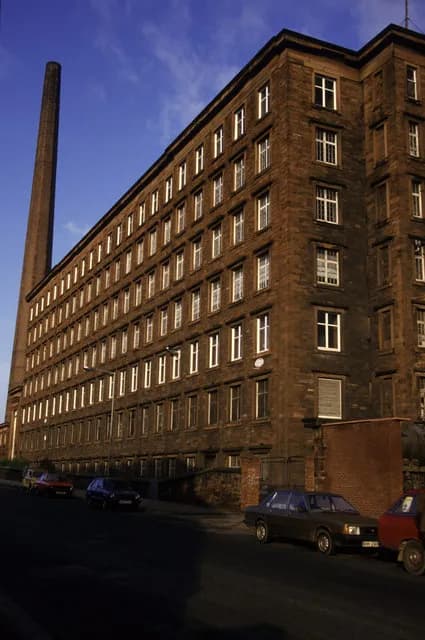
Rising above the Denton Holme skyline, Dixon's Chimney has dominated Carlisle's southern approach for nearly two centuries. The octagonal brick tower stands 290 feet tall, a remaining testament to the city that once styled itself a cotton kingdom to rival Lancashire.
Peter Dixon, a merchant from Whitehaven who moved to Carlisle in 1812, commissioned the chimney in 1836. He engaged Manchester architect Richard Tattersall to design a structure that would carry smoke clear of the city whilst serving what was then the largest cotton mill in England. The Carlisle Journal recorded the laying of the last stone on 29 October 1836.
The original specifications reveal the ambition of the project. The chimney rose to 305 feet, with an internal diameter of 17 feet 6 inches at the base and walls 10 feet thick. Constructed in English bond brickwork with flush red sandstone quoins, the shaft tapers without plinth or cap, secured by iron tie-bands at top and bottom. Shaddon Mill itself measured 124 feet long, 58 feet wide, and 83 feet high, containing 351 windows.
The Dixon Industrial Empire
At its height, Peter Dixon and Sons employed approximately 8,000 people across four mills in the Carlisle area, including operations at Dalston, Warwick Bridge, and Cummersdale. The firm operated some 122,000 spindles and, in 1840 alone, employed 3,571 hand loom weavers, including workers in England, Scotland, and Ireland.
Cotton had become Carlisle's staple industry from the late eighteenth century onwards. The city's waters, particularly the River Caldew, were prized for bleaching, and calico-printing was introduced locally in 1761. The American Civil War in the 1860s devastated the trade; Carlisle's mills had supplied gingham patterns to slave plantations, and the free population that followed demanded different designs that local manufacturers struggled to provide. By 1884, the cotton trade had largely departed.
The Dixon enterprise collapsed in 1883, entering liquidation after seven decades of operation. Robert Todd and Sons Ltd acquired the mill, converting production from cotton to wool. The name Dixon, however, remains honoured in Carlisle to this day.
Heritage and Preservation
Shaddon Mill received Grade II* listing in 1949, with Dixon's Chimney following on 13 November 1972. The structure suffered lightning damage in 1931, and in 1950 the top 10 metres were removed for safety reasons, reducing the height to its present 290 feet.
Carlisle City Council restored the chimney in 1999. Story Homes converted much of the mill complex into residential apartments in 2005, whilst the University of Cumbria now occupies portions of the site. The chimney remains one of the most recognisable industrial monuments in the region, visible for miles across the surrounding countryside.
A Tragic Modern Chapter
On 27 October 2019, the chimney became the site of a tragic incident that drew national attention. Phil Longcake, aged 53, climbed the structure and became trapped, dangling upside down for more than 14 hours with his foot wedged between the chimney and a ladder. Emergency services were unable to reach him in time, and he was confirmed deceased at 4:46 pm. An inquest later revealed Mr Longcake had been struggling with mental health issues.
The incident underscored the chimney's enduring hold on local imagination and its continued prominence in Carlisle's urban landscape, nearly two centuries after it first rose above the city.