Between 1916 and 1971, Carlisle became the unlikely setting for one of Britain's most unusual social experiments: the state ownership and management of every pub, brewery, and off-licence in the city.
The Carlisle and District State Management Scheme began in 1916 as a wartime emergency measure. The government had established HM Factory, Gretna, Britain's largest cordite factory, to produce explosives for the First World War. The factory employed over 16,000 workers at its peak, including 11,576 women known locally as the "Gretna Girls". Faced with the potential for widespread drunkenness among this workforce, the state took the unprecedented step of nationalising all alcohol production, distribution, and retail in Carlisle and the surrounding district.
The Birth of the New Model Inn
The scheme's chief architect, Harry Redfern, left a lasting mark on Carlisle's built environment. He designed 14 "New Model Inns" in the Arts and Crafts style, spacious and well-lit establishments intended to replace the cramped, substandard pubs that had dominated the Victorian era. Only one of these pubs was built outside Carlisle city boundaries.
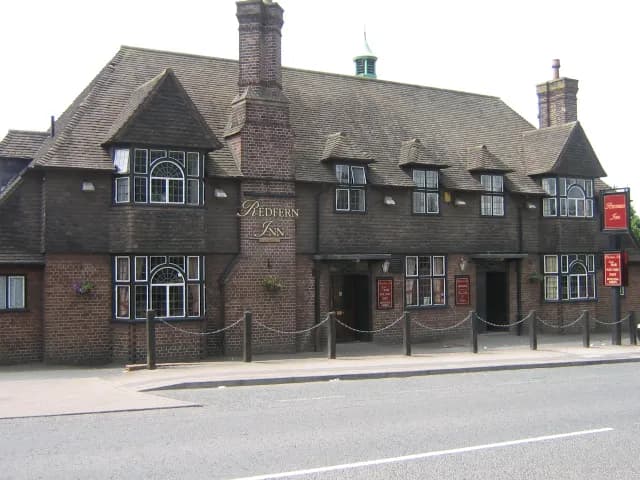
The final New Model Inn, the Redfern Inn in Etterby, was completed in 1940 and named in honour of its designer. The pub, designed by Redfern's assistant Joseph Seddon with his collaboration, stands as a tribute to a man who dedicated his career to improving the design and atmosphere of British public houses. The Redfern Inn remains a listed building and continues to serve the local community.
Redfern's innovations extended beyond architecture. He introduced features that would influence pub design across Britain: separate rooms for different social groups, family-friendly spaces, gardens, and improved facilities. His vision transformed the pub from a male-dominated drinking den into a more inclusive social venue.
The Rules of the Scheme
The state management scheme operated under distinctive principles. Managers received fixed salaries rather than profits from alcohol sales, creating what officials called "disinterested management". This removed the incentive to push drink on customers.
Between 1916 and 1919, the scheme enforced a strict "no treating" policy. Customers could not buy rounds of drinks for others, a measure designed to reduce excessive consumption and keep munitions production on track.
The scheme was one of three state management experiments in Britain. The others covered Cromarty Firth in Scotland and Enfield in Middlesex. The Enfield scheme ended in 1922 when its premises returned to private ownership. In 1921, Carlisle and Gretna were split into separate administrative areas, with Carlisle becoming the dominant territory.
Fifty-Five Years of State Control
What began as a temporary wartime measure lasted for 55 years. The Carlisle and District State Management Scheme outlived both world wars and became a fixture of local life, known simply as "The Scheme".
The state-owned Carlisle brewery supplied not only the city's pubs but also sent beer to Gretna. The arrangement proved remarkably durable, surviving multiple changes of government and the post-war nationalisation debates that swept through other British industries.
Privatisation and Aftermath
The experiment ended in 1971 when Edward Heath's Conservative government privatised the scheme. Assets were sold at auction in six lots to established brewing companies. The Carlisle brewery itself was acquired by T&R Theakston, the Yorkshire brewer, which took over production to meet growing demand.
The sale marked the end of an era. For half a century, Carlisle had operated under a system unique in British history: a city where every pint was poured, every measure measured, and every brewery operated by the state.
Legacy in Carlisle Today
The architectural legacy of the Carlisle Experiment remains visible in the city's streetscape. Several of Redfern's New Model Inns continue to operate, their distinctive Arts and Crafts features distinguishing them from typical Victorian and modern pub architecture.
The Redfern Inn stands as the most tangible monument to the scheme, named for the architect whose vision shaped a generation of Carlisle's public houses. The building represents not only a distinctive period in British architectural history but also a unique chapter in the social history of the city.
The Carlisle Experiment demonstrated that state ownership of alcohol retail could function for decades, even as the rest of Britain moved toward increasing privatisation. It stands as a reminder of how wartime emergency measures could evolve into long-running institutions, and how a city of Carlisle's size could become a testing ground for social policies that influenced national debates about alcohol, public health, and the role of the state in everyday life.